

Top 10 Venue Trends Meeting Planners Can’t Afford to Ignore in 2026
If you’re planning meetings in 2026, you already know the old assumptions are breaking down. Attendance isn’t loyalty. Fewer professionals are showing up. Even fewer are paying attention.
For corporate, association and medical planners, that shift is sharpening the focus on venue selection. With budgets flat and membership drifting, location is no longer a backdrop. Planners juggling ROI, DEI, and learning outcomes, have identified the venue as a strategic asset – or a silent drag on performance.
But what separates a space designed for real outcomes from one that just photographs well? The best venues in 2026 won’t be the flashiest: they’re purpose built for what today’s planners are asking for – and for what tomorrow’s attendees will expect.
Learn what’s defining the smartest meeting spaces of 2026 – and how to spot them before anyone else does.
1. Spaces That Flex with Your Agenda – and Your Audience
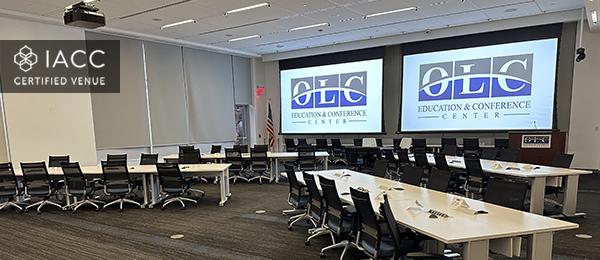
In 2026, planners expect venues to accommodate shifting formats without downtime. That means moveable walls, reconfigurable furniture, multi-use lighting, and acoustic flexibility – not just ballrooms with pipe and drape. Agendas now toggle between keynote, hands-on session, small group problem-solving, and hybrid broadcast. Something as simple as rotating table orientation between sessions – say, from lecture to roundtable – can reset attention and facilitate collaboration. At venues like OLC, clients consistently report stronger engagement when the room setup reinforces the goal of the session.
2. Smart Infrastructure Beats Shiny Surfaces
According to IACC’s 2025 report, planners rank seamless Wi-Fi and customizable hybrid-ready AV among their top priorities – above aesthetics or even cost in many cases. That means every meeting room should come equipped with mics, built-in streaming, streaming cameras, and a support tech who’s not offsite on a call. At the OLC, “Invisible infrastructure” isn’t a luxury – it’s the standard.
3. The Return of the Specialist Venue
51% of planners now prefer specialty venues (e.g. medical, training, university, or cultural centers) over traditional hotels – a dramatic shift from 33% two years earlier. Purpose-built spaces win when they provide dedicated staff, focused environments, and event-specific infrastructure. Venues that aren’t designed for learning, collaboration, or technical performance will struggle to keep bookings.
4. Pricing Models Must Be Frictionless and Custom
RFPs now include detailed asks about pricing structure. Bundled day rates and predictable per-person packages are in; layered service fees, AV surprises, and unclear food minimums are getting venues cut early. Clients want to quote once and sell the value internally – not unravel a spreadsheet of variable charges post-contract.
5. Fewer Attendees, Higher Stakes: Planners Are Prioritizing Quality Over Quantity
With attendance shrinking and expectations rising, planners are demanding spaces that support richer interaction. Networking layouts, lounge seating, quiet areas, and walkable formats all matter. A 100-person hall that can’t foster engagement across multiple spaces is now a liability.
6. Hybrid Is Not an Add-On – It’s a Design Standard
Even if no remote guests are expected, venues must be hybrid-ready. That means integrated streaming, backup connectivity, live captioning options, and the ability to switch to remote with zero drama. For events with international or health-sensitive participants, “hybrid as fallback” is now the rule. Excellent planners choose venues like the OLC for their readiness and quick ability to switch gears.
7. Sustainability Data Isn’t Optional Anymore
31% of planners now prioritize venues with verified green practices; 23% require carbon impact assessments as part of their decision-making. That includes waste tracking, energy usage, food sourcing, community relationships, and now more and more often – IACC or other green certification. Venues should have a one-sheet sustainability report ready to share.
8. Attendee Wellness Now Starts with the Floorplan
Burnout and attention fatigue aren’t theoretical anymore. Planners are building in breaks, breathing space, and wellness support-but they expect venues to make that easier. Think light-filled rooms, ergonomic chairs, natural materials, quiet areas, on-site greenspace, and no more 12-hour days in a windowless basement.
9. Flexibility in Risk Management Is a Competitive Edge
Booking windows are shortening and backup plans are required. Planners now ask whether contracts include flexible cancellation, hybrid pivoting, rescheduling credits, and emergency comms protocols. The winning venues in 2026 are the ones that work with clients on these requests.
10. The Best Venues Don’t Just Deliver – They Partner
Planners are gravitating toward venues with full-service, high-touch teams that behave like event collaborators, not just facility managers. At IACC-certified venues like OLC, concierge-style teams offer layout guidance, vendor coordination, tech assistance, and flexible scheduling – all before planners have to ask. That proactive mindset is now a competitive edge, especially for medical, association, and training events where precision matters.
As the year winds down, the pressure to do more with less hasn’t gone away – but neither has the opportunity to rethink how meetings work. For planners and venues willing to prioritize clarity, quality, and service, 2026 offers a clearer path forward. And the best outcomes, as always, start with getting the space right.